Your Cart is Empty


Design Software History: DFMA and the Rise of Manufacturing-Aware Design Software
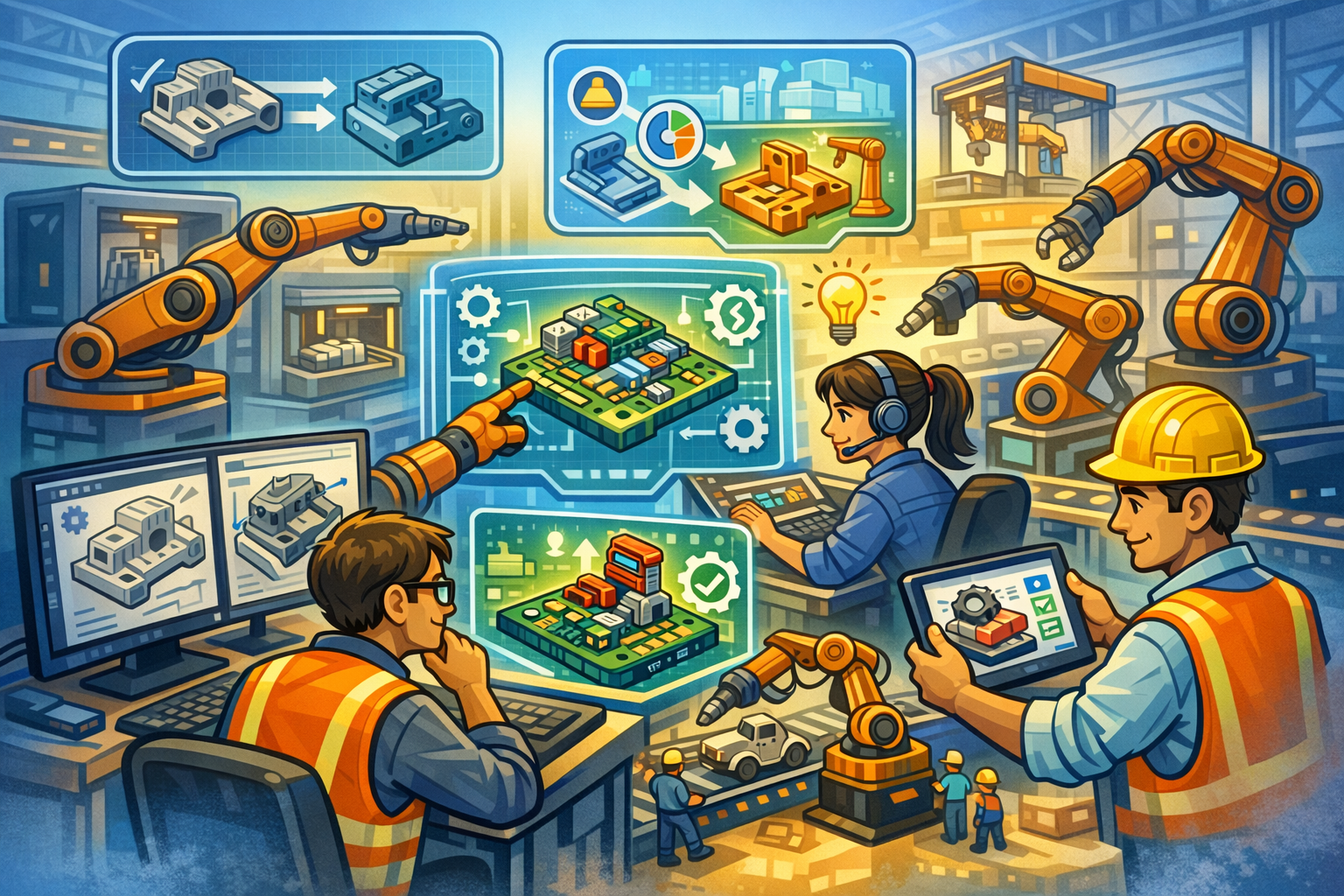


In the history of engineering software, few developments were as consequential as the effort to bring manufacturing and assembly knowledge directly into the design environment. That effort produced what became known as Design for Manufacturing and Assembly, or DFMA, a field that changed the meaning of computer-aided design from the creation of geometry to the support of industrial decisions. Its rise was not simply a story about better software features. It was a response to a long-standing divide between what engineers could draw and what factories could reliably build, assemble, cost, and scale across regions, suppliers, and production systems.
Why manufacturing and assembly knowledge had to enter design software
The pre-software world of drawings, tacit expertise, and manual review
Before engineering software began to encode manufacturing knowledge, product development depended on a layered process of interpretation. Designers produced drawings, sometimes with extraordinary precision, yet those drawings represented only part of the industrial truth. The rest lived in the minds of toolmakers, manufacturing engineers, assemblers, purchasing specialists, and quality inspectors. A drawing could specify dimensions, tolerances, materials, and notes, but it rarely captured the practical realities of fixture design, tool reach, operator handling, fastening sequence, mold draft, machining setup count, or the awkwardness of assembling a part in a crowded enclosure. In machine shops and factories, this missing information was supplied by experienced people who had learned through repetition where nominally correct designs became expensive, fragile, or impossible in production. Review processes were therefore manual, sequential, and deeply dependent on human judgment. A design moved from drafting to manufacturing review, then perhaps to tooling, procurement, and quality planning, with each handoff exposing new constraints that had not been visible in the drawing itself. The result was often a cycle of redesign driven not by function alone but by overlooked production realities.
Why drawings were not enough even when they were excellent
This pre-software condition matters because it explains why DFMA could not emerge simply as an extension of drafting. A product might be completely documented and still be poorly designed for production. The industrial challenge was not merely to describe parts accurately but to reduce part count, simplify assembly, minimize handling difficulty, avoid unnecessary fasteners, improve tolerance robustness, and align design intent with available manufacturing processes. In sectors such as automotive and aerospace, where production volumes, certification demands, and supply chains were large and unforgiving, the cost of late discovery was severe. In consumer products, where margins were tight and launch windows narrow, excessive assembly time or tooling complexity could erase profitability. What later became software logic began as shop-floor experience translated into review checklists, red marks on drawings, and arguments at design meetings. Those practical interventions were often effective, but they scaled poorly. They depended on finding the right expert at the right time, and they occurred late enough that improvements were expensive to implement. The need was clear: the insights of manufacturing had to move closer to the point where design choices were made.
DFMA as both a methodology and a software challenge
DFMA emerged to address that need on two levels at once. As a methodology, it provided a disciplined way to ask whether parts were necessary, whether assemblies could be simplified, whether a component could be produced with fewer operations, and whether cost and quality could be improved by changing the design before release. As a software challenge, it required systems that could represent not only shape but also process implications. This was much harder than it first appeared. Manufacturing and assembly knowledge rarely fits neatly into exact mathematical formulas. Some of it can be expressed geometrically, such as wall thickness consistency, undercuts, draft angles, hole depth-to-diameter ratios, bend radii, or tool accessibility. Much of it, however, is heuristic and contextual. The “best” design depends on expected volume, labor rates, machine capability, supplier maturity, material availability, fastening strategy, tolerance stack behavior, and assembly sequence. A DFMA system therefore had to do more than measure geometry. It had to infer likely processes, relate form to cost drivers, and offer guidance before every detail was finalized. That combination of rules, estimates, and process expertise made DFMA one of the earliest serious attempts to turn design software into a medium for industrial reasoning rather than pure documentation.
Why early CAD systems were necessary but insufficient
The first generations of CAD transformed engineering by making drawings faster to create, edit, and distribute. Systems from companies such as Computervision, Applicon, Intergraph, and IBM changed how geometry and drafting were handled in aerospace, automotive, and industrial equipment sectors. Later, solid modeling systems advanced the state of product definition further, with influential work from Romulus, Parasolid, ACIS, and feature-based modelers from Parametric Technology Corporation, SDRC, and others. Yet even as these tools improved the descriptive power of digital design, they did not solve the manufacturability problem on their own. A solid model could precisely define a part and still reveal very little about whether a chosen process was sensible, whether the design would require expensive tooling actions, or whether operators could physically assemble it without awkward maneuvers and defect risks. Geometric description did not equal manufacturability. CAD could automate drafting and later support parametric updates, but drafting automation did not capture process constraints in a form that guided decisions with enough economic and operational context. The digital model was exact about shape while remaining incomplete about production reality.
The missing knowledge between geometry and production
This gap became especially obvious in assemblies. Engineers could model mating parts, clearances, and nominal fit, but assembly success depends on far more than interference checking. It depends on insertion direction, fixture needs, fastening access, hand clearances, orientation symmetry, risk of incorrect installation, order of operations, and the cumulative burden of part variety. A model might show that two parts fit together while saying nothing about whether a screwdriver could reach the fastener, whether a worker would need to reposition the assembly repeatedly, or whether replacing three custom brackets with one multifunctional stamping would reduce cost and defects. Those judgments still lived with experienced engineers and manufacturing planners. Early CAD systems also struggled to connect features to process meaning in a robust way. A hole was geometry, but was it to be drilled, cast, punched, molded around, or formed in a secondary operation? A thin wall might be acceptable in one molded polymer and disastrous in another. A pocket might be easy in one machining setup and expensive in another requiring long tools and lower rigidity. Without explicit process intelligence, CAD remained a sophisticated representation system rather than a full decision-support environment.
Industrial pressure made the problem impossible to ignore
The demand for DFMA software intensified because product-development economics changed sharply in the late twentieth century. Development cycles shortened as competition accelerated and global markets rewarded faster launches. Product complexity rose as electromechanical integration, electronics packaging, safety requirements, and customer customization increased the number of interdependent design decisions. Manufacturing itself became more global, with components and subassemblies sourced across continents, making assumptions about process capability and labor availability less stable than in vertically integrated production systems. At the same time, major cost-reduction programs swept through automotive, aerospace, appliances, electronics, and consumer products. Executives expected engineering to remove cost upstream rather than negotiate it away after designs were frozen. In automotive, recurring pressure to reduce assembly content and rationalize part counts made design simplification a strategic objective. In aerospace, where nonrecurring engineering, certification, and manufacturing quality were tightly linked, avoidable complexity was especially expensive. In consumer products, where margins and volumes magnified the effect of every assembly second and every extra component, design decisions directly shaped competitiveness. Under these conditions, software that could expose manufacturing consequences early was no longer a convenience. It became an organizational requirement.
What industry began to expect from software
As pressure mounted, engineering organizations began to expect software to answer questions that previous CAD generations were never designed to answer. They wanted earlier cost visibility, methods to compare alternative concepts before detailed tooling plans existed, and structured ways to challenge unnecessary parts and fasteners. They also wanted repeatability. A company could not rely indefinitely on a few veteran engineers to remember all the lessons of moldability, machining economy, and assembly simplification. Industrial knowledge had to be formalized so it could be taught, reused, audited, and deployed across teams in different locations. This expectation set the stage for DFMA software. It did not emerge because geometry systems failed in their own terms; it emerged because industry needed systems that connected shape to process, cost, and organizational learning. Once that expectation took hold, the design software landscape began to evolve from representation toward integrated engineering judgment.
The people, companies, and methods that shaped DFMA in software
Geoffrey Boothroyd and Peter Dewhurst formalized the field
Few individuals are more central to the history of DFMA than Geoffrey Boothroyd and Peter Dewhurst. Boothroyd, an engineer and academic with deep expertise in manufacturing processes, devoted substantial effort to understanding how production economics and process selection could be analyzed systematically rather than left to intuition alone. Dewhurst worked with Boothroyd to develop practical methods that engineering teams could apply in commercial settings, especially around assembly simplification and manufacturability evaluation. Their contribution was significant because they transformed a broad industrial sentiment, namely that designs should be easier and cheaper to build, into a structured methodology with teachable questions, measurable criteria, and comparative scoring. The Boothroyd-Dewhurst approach asked whether each part had a fundamental reason to exist as a separate component, whether it had to move independently, whether it required a different material or process, and whether combining parts might reduce handling and assembly effort. This was not merely common sense put into pamphlet form. It was an attempt to build a portable analytical language that could travel across industries and be used by engineers, managers, and manufacturing teams to challenge complexity at its source.
From consulting method to deployable software
The next crucial step was organizational and technical: turning methodology into software. Boothroyd Dewhurst, Inc. became the company most closely associated with this transition. The firm translated consulting methods and paper-based evaluation frameworks into software tools that engineering teams could use repeatedly during product development. This mattered because a method taught in workshops or applied during consulting engagements has limited reach unless it becomes operational inside everyday engineering work. By codifying assembly-time estimation, handling difficulty assessment, fastening evaluation, and manufacturing cost logic, Boothroyd Dewhurst made DFMA more than a philosophy. It became an executable engineering practice. Software allowed teams to compare design alternatives in a disciplined way, generate structured justifications for part elimination, and communicate the cost implications of design complexity to managers and cross-functional partners. It also created consistency. Instead of every review being shaped entirely by who happened to be in the room, organizations could use a shared framework with traceable assumptions. In historical terms, this was a major step in the maturation of design software: expertise once delivered through authority and experience began to be expressed through interfaces, databases, and computational rules.
How DFMA fit into the larger CAD/CAM and PLM world
DFMA software did not develop in isolation. It entered a rapidly expanding ecosystem that included CAD, CAM, product data management, and eventually PLM, or Product Lifecycle Management. Vendors such as Dassault Systèmes, PTC, Siemens, and Autodesk did not all embrace DFMA in identical ways, but their platforms increasingly moved toward embedding manufacturing-aware logic in design workflows. Dassault Systèmes, through CATIA and later broader lifecycle platforms, linked product definition more tightly to downstream manufacturing and enterprise context. PTC, whose Pro/ENGINEER helped define parametric feature-based design, contributed to the idea that design intent and editable features could become carriers of process information rather than static geometry alone. Siemens, through Unigraphics, NX, and related digital manufacturing capabilities, advanced integrated engineering environments where design, manufacturing planning, and simulation increasingly interacted. Autodesk, while historically more associated with drafting and broad design accessibility, also participated in expanding manufacturability-oriented workflows across mechanical design and fabrication contexts. The significance of these companies lies not in claiming that each created DFMA as a discipline, but in recognizing that the industry’s major software platforms gradually absorbed the expectation that design tools should help engineers make manufacturable, cost-aware decisions rather than simply model parts.
What kinds of capabilities DFMA software introduced
The capabilities that emerged under the DFMA umbrella were diverse, but they shared a common aim: making production consequences visible early enough to influence design. Typical functionality included the following:
- Part count reduction analysis, which challenged whether components were truly necessary as separate items and quantified the design and assembly penalties of excess parts.
- Assembly time estimation, often based on handling and insertion characteristics, helping teams evaluate labor content before physical build trials.
- Fastening and handling evaluation, addressing orientation difficulty, symmetry, graspability, accessibility, and the burden imposed by screws, clips, adhesives, and other joining methods.
- Cost modeling tied to manufacturing processes, allowing rough comparisons among machining, molding, casting, stamping, and fabricated alternatives even when detailed quotes were unavailable.
- Process-specific guidance for injection molding, machining, die casting, sheet metal, and related processes, often highlighting likely problem areas such as undercuts, thin walls, deep cavities, difficult bends, or excessive secondary operations.
These capabilities reflected a major conceptual shift. Instead of treating the factory as something that receives a finished design, DFMA software treated manufacturing as an active participant in design evaluation. Some tools remained largely tabular and rules-based, whereas others began integrating more closely with CAD geometry and feature structures. Together, they established a new category of engineering software focused on simplification, feasibility, and cost consequences.
The gradual move from standalone expertise to integrated workflow
Early DFMA tools were often used as specialist applications, sometimes by manufacturing engineers or cost engineers who operated somewhat outside the main CAD environment. That made sense at first because the methods themselves were specialized and because hardware, data exchange, and software architecture limited integration. Over time, however, industry pressure pushed DFMA toward tighter workflow connection. Engineering teams wanted product structures, features, materials, and design revisions to flow more directly into manufacturability and assembly analyses. They also wanted the outputs of those analyses to feed sourcing, quality planning, and program management decisions. This encouraged a shift from standalone expert tools toward more integrated workflows linked to CAD models, PDM systems, and eventually PLM platforms. The historical importance of this transition should not be understated. It represented the absorption of manufacturing logic into the everyday digital fabric of product development. What had once been a separate review discipline increasingly became a design-time software behavior. In that transition, the legacy of Boothroyd, Dewhurst, and related practitioners spread far beyond any single toolset, influencing how the broader design software industry conceived the relationship between product geometry and industrial execution.
How DFMA software changed design processes and engineering culture
Moving manufacturing concerns earlier in development
The most important effect of DFMA software was procedural as much as technical: it pushed manufacturing concerns upstream. In older development patterns, many manufacturability issues were discovered after designs had reached a high level of maturity, when drawings were nearly complete, suppliers had begun quoting, or pilot builds had exposed practical limitations. At that stage, useful changes were possible but costly. DFMA software made it easier to ask earlier whether a concept was intrinsically too complex, whether assembly content could be reduced, or whether a geometry choice would likely force expensive process decisions. This changed the economics of product development. A recommendation to eliminate two fasteners or combine several molded pieces into a single part has the greatest value when made before tooling, tolerance schemes, procurement planning, and validation schedules are fully committed. In that sense, DFMA software altered the timing of knowledge. It did not simply help engineers make better decisions; it helped them make those decisions while they were still economically reversible. That timing advantage is one reason DFMA became influential even where its models were imperfect. Earlier directional guidance often mattered more than later precision.
Its connection to concurrent engineering
DFMA also aligned closely with the rise of concurrent engineering, the organizational philosophy that product development should involve design, manufacturing, sourcing, and quality considerations in parallel rather than in a strict sequence. During the late twentieth century, many industrial firms recognized that serial handoffs produced delay, redesign, and defensiveness between departments. DFMA software offered a practical instrument for breaking down those silos because it created a shared language around part count, assembly effort, process suitability, and cost drivers. Instead of manufacturing reacting after design decisions had hardened, teams could review alternatives together with a structured basis for discussion. That encouraged:
- closer collaboration among design, manufacturing, sourcing, and quality teams,
- fewer late-stage engineering changes caused by overlooked production constraints,
- stronger feedback loops between digital models and factory realities,
- better communication with suppliers about process assumptions and cost structure,
- greater managerial visibility into how design complexity translated into time and money.
The cultural effect was substantial. Manufacturing expertise gained a more formal seat at the design table, not only through meetings but through software-mediated evaluations that gave those concerns persistence and visibility. DFMA thus helped rebalance engineering culture away from a narrow celebration of form and function alone and toward a broader recognition that product excellence includes the ability to be built well.
The technical difficulty of encoding manufacturing knowledge
Embedding manufacturing knowledge into software, however, was never straightforward. Some engineering domains admit elegant exact computation. Geometry kernels can determine intersection, adjacency, topology, mass properties, and many forms of constraint behavior with mathematical rigor. Manufacturing judgment often resists that kind of formalization. A DFMA system must decide how much to rely on explicit rules and heuristics versus exact geometric analysis. For example, draft angle can be measured precisely, but whether draft is sufficient depends on material, tool finish, part depth, ejection strategy, and quality expectations. A machined pocket can be recognized geometrically, but machining cost depends on setup strategy, machine availability, tool selection, surface finish requirements, tolerances, stock form, and achievable cycle times. Software therefore had to combine computational geometry with engineering heuristics, process templates, empirical tables, and assumption-driven cost models. That hybrid nature explains why DFMA systems often felt different from traditional CAD. They were not trying merely to represent shape; they were trying to represent industrial plausibility. Historically, this makes DFMA an early and important example of knowledge-based engineering, where software attempts to encode expert reasoning in a reusable digital form.
Linking CAD features to process plans and cost estimates
One of the hardest technical problems was connecting CAD features to plausible process plans. Feature-based modeling offered promise because holes, bosses, ribs, pockets, fillets, bends, and patterns are closer to manufacturing language than raw surfaces and edges. Companies such as PTC popularized parametric feature modeling in ways that suggested a richer bridge between geometry and downstream reasoning. Yet the bridge was never automatic. A design feature does not uniquely determine a manufacturing feature, and a manufacturing feature does not uniquely determine a process plan. A rib in a plastic part may influence mold filling, warpage, and sink behavior; a pocket in a metal part may imply roughing and finishing operations; a bend in sheet metal may affect springback, tooling selection, and sequence feasibility. Cost estimation from incomplete design information added another layer of uncertainty. Early in development, dimensions may be fluid, tolerances may be provisional, suppliers undecided, and production volumes uncertain. DFMA software had to provide useful guidance in exactly that incomplete state. Its outputs were therefore often probabilistic or assumption-based in spirit, even when presented through deterministic interfaces. This was not a flaw so much as a reflection of product development itself: engineers need actionable approximations long before they have perfect information.
The limits and tensions of DFMA software
For all its value, DFMA software also has fundamental limits. Its recommendations depend on assumptions about factories, suppliers, process capability, labor content, automation level, and production volume. A design optimized for high-volume automated assembly in one region may be suboptimal for lower-volume mixed-process production elsewhere. Rules that make sense in consumer electronics may not transfer cleanly to aerospace interiors, medical devices, or heavy equipment. The software can also conflict with other legitimate design objectives. Aesthetics may call for hidden fasteners, seamless surfaces, or premium materials that complicate assembly. Lightweighting may introduce thin sections or complex geometries that are harder to manufacture but necessary for performance. Serviceability may favor modularity and separate parts where assembly simplification would prefer integration. Safety, reliability, thermal behavior, acoustics, and regulatory compliance can all justify choices that appear inefficient in a narrow assembly-time model. These tensions are important historically because they reveal both the power and the boundary of DFMA thinking. It is not a replacement for engineering judgment; it is a way to sharpen it by making tradeoffs more explicit. The enduring lesson is that software cannot abolish complexity, but it can expose where complexity is essential and where it is merely inherited habit.
Why its cultural legacy endured
The deeper legacy of DFMA software lies in what it taught engineering organizations about digital decision support. It demonstrated that software could carry expert industrial knowledge, shape design conversations, and change incentives long before final documentation. It also helped legitimize the idea that factories and supply chains belong conceptually inside the design environment, not at its edge. That lesson influenced later advances in design rule checking, manufacturing simulation, cost analytics, and lifecycle platforms. Even where dedicated DFMA tools were not universally adopted, the mentality they promoted persisted: fewer parts, simpler assembly, earlier cost insight, and stronger connection between digital models and production realities. In historical perspective, this was a cultural transformation as much as a technological one. Engineers increasingly came to expect that a model should not only describe a product but also help forecast the consequences of building it.
Conclusion
From shape creation to downstream awareness
The history of DFMA software is, at its core, the history of design software becoming aware of downstream reality. In the earliest eras of engineering computing, digital tools excelled when the task was geometry, drafting, and later parametric modification. Those achievements were foundational, but they left unanswered the harder industrial question of whether a product, however elegant on screen, could be manufactured and assembled efficiently in the real world. DFMA addressed that gap by bringing manufacturing knowledge, assembly logic, and cost sensitivity into the design conversation much earlier. Through the work of people such as Geoffrey Boothroyd and Peter Dewhurst, and through the commercialization efforts of Boothroyd Dewhurst, Inc., the field gave engineers structured methods to challenge unnecessary complexity. Through the broader evolution of software platforms from companies such as Dassault Systèmes, PTC, Siemens, and Autodesk, those ideas gradually spread into a wider ecosystem where design tools increasingly carried manufacturing implications alongside geometric intent.
The lasting legacy in modern engineering software
What DFMA ultimately changed was the role of CAD itself. It helped shift digital design from shape creation toward decision support. That legacy is visible today in manufacturability analysis tools, process-aware costing systems, feature-based process planning, generative design constraints, tolerance-driven quality analysis, and digital thread platforms that attempt to connect design, production, and service data across the life of a product. Modern systems may use different terminology, richer simulation, cloud computing, and broader enterprise integration, but they continue to pursue the central DFMA ambition: exposing the downstream consequences of design choices before those choices become expensive to reverse. Looking ahead, the most capable future DFMA systems will likely combine geometry kernels, simulation engines, supplier and supply-chain data, factory capability models, and AI-based inference. Yet even as their technical sophistication grows, their essential purpose will remain unchanged. They exist to help engineers create products that can actually be built, assembled, and delivered with efficiency, quality, and economic discipline. That is why DFMA remains one of the most important chapters in the history of design software.
Also in Design News