Your Cart is Empty


Design Software History: Collaboration in Design Software: From File-Based PDM to Cloud-Native Co-Editing and Design Threads
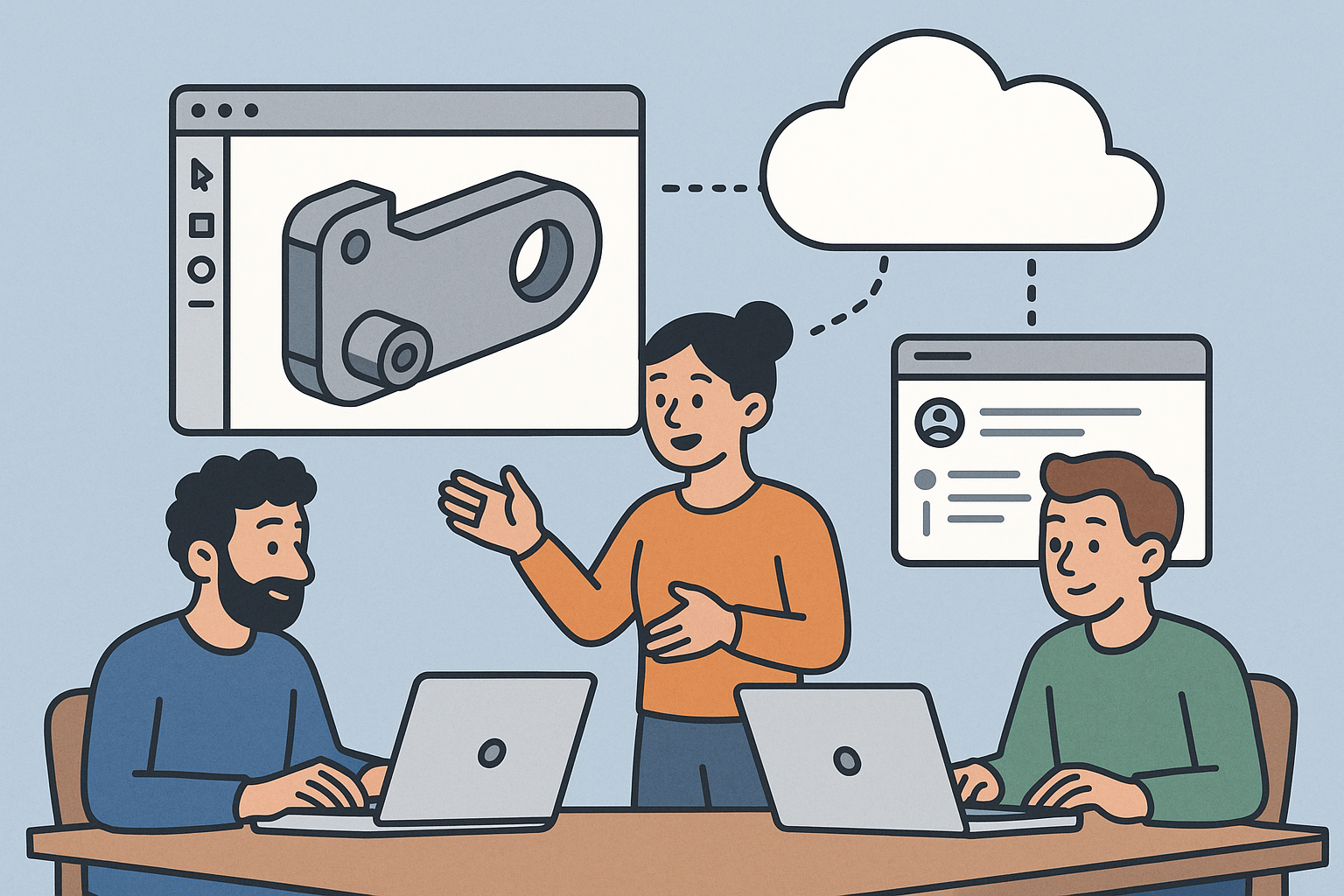


Why Collaboration in Design Software Changed, and Why It Matters Now
A short context for a long arc
Collaboration in design software has evolved from moving files and markups around to co-authoring living, shared documents. This arc reshaped not only how geometry is produced but how decisions are argued, justified, and remembered. It began with redlines on plots and slow handoffs via network drives, detoured into PDM/PLM processes that treated collaboration as paperwork, and eventually arrived at cloud-native systems where comments, presence, and edits coexist inside the model. Each step brought new metaphors—check-in/check-out, central models and reservations, real-time co-editing—and new pain points, from brittle interop to topology instability. What follows traces the technical and cultural moves behind that shift, highlights the roles of companies and people who catalyzed it, and explains why the next competitive frontier is turning design threads into institutional memory rather than ephemeral chat.
How to read this evolution
This history is not just about better viewers or faster sync; it is about how coordination primitives moved closer to geometry itself. Early systems separated comments from models and turned change into forms. Later systems embedded identifiers and deltas so teams could share intent, not just surfaces. Today, a blend of service-backed documents, streaming viewers, and anchored comments promises to make collaboration the primary modeling metaphor. The critical questions—stable references, multi-discipline context, and durable rationale—are finally being treated as first-class engineering problems, with standards bodies and platform vendors converging on shared scaffolding. Understanding where we came from clarifies why modern tools feel different: the work is increasingly a conversation that the model itself hosts, remembers, and helps adjudicate.
From Files and Redlines to PDM: The Prehistory of Collaboration (1970s–2000s)
Metaphors that governed coordination
The original collaboration metaphor was sequential ownership. Designers treated local files and network drives like physical drawings: it was “my turn/your turn,” with handoffs at predictable gates. The core coordination primitive was check-in/check-out paired with file locking. If someone had the file, others waited. Offline markups started as pen-on-plots and evolved to email attachments, then into electronic redlines inside DWF/PDF readers. The model remained a private workspace; collaboration happened before or after edits, but rarely during them. This rhythm encoded scarcity: compute power, bandwidth, and trust in shared edits were limited, so the safest workflow was taking turns.
Systems and companies that shaped the era
Early PDM/PLM systems formalized that metaphor. PTC Windchill—with leadership including Jim Heppelmann—emphasized product data control and lifecycle states. Dassault Systèmes ENOVIA under Bernard Charlès extended configuration management across CATIA enterprises. Siemens Teamcenter and Autodesk Vault provided check-in/check-out, version histories, and permissions at file granularity for MCAD; in AEC, Bentley ProjectWise orchestrated document management on large infrastructure projects. For view/markup, Autodesk Design Review popularized DWF, JT2Go streamlined JT visualization, and 3D PDF (Adobe with Tetra4D) pushed lightweight 3D into ubiquitous readers, while Navisworks aggregated heterogeneous models for coordination and clash review.
Technical realities that imposed limits
File granularity forced coarse locks and slow handoffs. When a part or drawing is the locking unit, concurrency collapses to queueing, no matter how many people are ready to work. Interoperability acted as a gatekeeper: IGES/STEP/JT/DWF became “collaboration formats,” but they were typically read-only. Comments, even when attached to a view, were detached from editable geometry. Hiding in email threads was the change rationale: why a fillet changed, why a dimension moved, who approved what. The lack of stable identifiers across systems meant traceability only existed in the PDM database, not within the model structure itself.
Cultural effects of paperwork-first collaboration
PDM/PLM workflows codified ECR/ECO as the center of collaboration, which ensured auditability but framed teamwork as paperwork. The CAD UI remained fundamentally single-user; co-workers discussed changes around the model rather than inside it. Teams optimized for handoff predictability, not for shared making. Over time, organizations learned to treat “collaboration” as a sequence of approvals, reviews, and status changes in PLM, while geometry manipulation stayed personal. That cultural separation left a gap between intent and edit history that future systems would try to close.
What this stage accomplished and where it stalled
These tools established essential building blocks:
- Versioning and permissions for traceable changes and role-based access.
- Lightweight visualization to broaden access beyond CAD seats.
- Lifecycle states to govern release, change, and archive.
- Detached comments that could not survive geometry edits.
- Coarse-grained locks that turned coordination into waiting.
- Interop bottlenecks that made collaboration formats second-class.
Worksharing Without Co-Editing: Central Models, Reservations, and Deltas (Late 1990s–2014)
Metaphors of shared space without simultaneity
The next shift was from locking entire files to reserving elements or features inside a shared central model. Teams could “check out” a wall, a family, a parameter set, or a feature tree segment while others worked elsewhere. The cadence was periodic sync/receive, not true real time: users pushed their changes to a central authority and pulled others’ edits at intervals. This kept the modeling UI familiar while reducing blocking. The metaphor was a studio with a single master canvas, where individuals taped off zones rather than waiting for the whole canvas. Coordination became a choreography of reservations, not a baton pass.
Pioneers and platforms that operationalized reservations
Graphisoft ArchiCAD Teamwork, championed by Gábor Bojár, introduced early BIM worksharing and eventually a Delta Server that transmitted granular changes rather than whole files. Autodesk Revit Worksharing, led by Leonid Raiz and Irwin Jungreis, built a central-file paradigm with element borrowing, allowing local edits to sync back while the central managed conflicts. In construction-connected workflows, BIM 360 and later ACC linked model issues with field observations. Bentley ProjectWise expanded from document control into distributed caching and orchestration for massive AEC projects, where bandwidth and latency were engineering constraints, not mere nuisances.
Issue-centric collaboration grows up
As worksharing took hold, issues became a first-class object. The BCF format from buildingSMART standardized the way BIM issues—viewpoints, comments, and minimal geometry references—moved among tools. This enabled workflows spanning Solibri (model checking), BIMcollab (issue management), Navisworks (clash coordination), and Trimble Connect (cloud sharing). Markups gained coordinates in model space, so comments could be pinned to a viewpoint with camera and section context. However, the conversation still lived largely in external systems, with models serving as backdrops rather than hosts of the dialogue.
Tradeoffs of reservations over real-time co-edit
Worksharing reduced blocking but introduced new risks. Merges were mediated by element ownership, not by edits-in-place; two people could change parameters that interacted, only to surface conflicts on sync. Comments tethered to objects but often broke when topology changed; the same door, redefined, might be a new object with a new ID. The notorious persistent ID problem emerged: how do you keep a comment attached when the geometric substrate is rewritten by feature ops or parametric regeneration? Reservations avoided the chaos of free-for-all editing, but the promise of seamless multi-user flow remained unfulfilled.
What improved and what remained missing
Improvements:
- Granular deltas cut down data transfer and enabled scalable sync.
- Object-level reservations reduced contention and waiting.
- Issue standards like BCF created interoperable comment payloads.
- No shared presence: you could not see a teammate edit a face or constraint live.
- Thread detachment: discussions still lived in portals and PDFs, not in the editable model history.
- ID fragility: topology-based references broke under normal modeling operations.
Live Co-Editing, Comments, and Design Threads: Cloud-Native Metaphors Arrive (2012–Present)
Real-time editing becomes a first-class capability
Cloud-native platforms reframed collaboration as multiplayer CAD and BIM. Onshape, founded by Jon Hirschtick with core technical leadership including Ilya Baran, introduced simultaneous editing with follow mode, in-document branching/merging, and a granular version graph. Autodesk Fusion 360 centered models as cloud documents with live review sessions, shared canvases, and @mentions, while ACC linked issues directly to model elements. Dassault 3DEXPERIENCE pushed xApps like xDesign and xShape into collaborative spaces, bringing SolidWorks users toward platform co-presence. In AEC, Graphisoft BIMcloud Next Gen and Trimble Connect extended near-real-time BIM collaboration, and open tooling such as Rhino + Speckle enabled multi-tool concurrency via data streams. UI metaphors borrowed from Figma (founded by Dylan Field and Evan Wallace) and the Google Docs OT era—avatars, cursors, and live cursors—reset expectations for presence.
Under-the-hood shifts make presence safe
The architecture moved from files to service-backed documents with operation logs—variants of OT/CRDT approaches—augmented by feature-graph diffs that describe modeling changes semantically rather than as byte deltas. Reproducibility was the new tension: parametric models demand deterministic solves, yet concurrent edits threaten order. Vendors converged on server-side solve as arbiter to ensure a single source of geometric truth, with conflicts resolved by operation ordering and intent rules. This allowed live edits without corrupting constraint systems, making presence not just performative but reliable.
Comments evolve into durable design threads
Comments are now anchored to faces, edges, features, sketches, or steps in the history tree, turning notes into design threads with @mentions, tasks, and resolutions. Onshape’s release candidates weave thread resolution into formal approvals. Fusion 360 and ACC integrate comments with PLM change objects, preserving rationale alongside state transitions. Viewers matured into collaboration hubs: Autodesk Platform Services/Forge Viewer, HOOPS, and glTF/USD streaming pipelines power web-scale review with sectioning, measurements, and redlines that remain tied to model topology as it evolves—when the IDs hold.
Hard problems and partial fixes for identity and context
Chief among the hard problems is topological naming: keeping references stable as geometry is regenerated. Strategies include kernel-level heuristics in Parasolid, the face-tracking ideas behind Synchronous Technology, feature-based IDs that derive stability from intent, and standard-driven approaches such as STEP AP242 persistent IDs. Multi-model context adds complexity: MCAD and ECAD collaboration via Altium 365 CoDesigner, CAE feedback loops, and manufacturing notes must co-exist without ID collisions. Standards ecosystems help: BCF moves issues, AP242 carries PMI and IDs, JT enables lightweight review, and USD/Omniverse support scene-level live sync across disciplines.
New coordination patterns users now expect
Modern teams expect:
- Live presence with cursor following and active region highlights.
- Branching and merging to explore, compare, and reconcile alternatives without duplicating files.
- Anchored tasks that move with geometry across versions and tie into releases.
- Shared viewers that render massive assemblies or federated BIM scenes in the browser with glTF/USD-backed streaming.
Limits that remain and why they matter
Even with live co-editing, limits persist:
- Topology instability still breaks references under radical edits, challenging thread durability.
- Determinism vs. concurrency means complex merges may still require human judgment.
- Cross-discipline identity is fragile when MCAD, ECAD, CAE, and BIM data intersect.
Conclusion: From Passing Files to Conversing Inside the Model
The arc in one sentence
We moved from collaboration as paperwork around geometry to collaboration as conversations embedded in geometry, evolving from “lock a file,” to “reserve an element,” to “co-edit a living document with design threads.” The framing matters: the closer conversation sits to editable intent, the better teams transmit rationale, coordinate change, and maintain continuity across releases.
What stuck and why it matters
Enduring patterns include:
- Live presence and anchored comments increase shared understanding and reduce coordination latency.
- Version graphs and branching tame change risk, enabling exploration without chaos.
- Issue standards (BCF) and model standards (AP242/JT/USD) keep threads portable across tools, preventing lock-in of rationale.
What’s next and who to watch
Critical fronts:
- Reliable topology anchors so comments survive regeneration and radical refactors.
- Cross-discipline design threads connecting MCAD/ECAD/CAE/BIM with automated traceability to ECOs and compliance artifacts.
- AI assistants that summarize long threads, propose merges, flag conflicting intents, and capture rationale as structured knowledge.
- Cloud-native leaders: Onshape/PTC, Autodesk Platform Services and Fusion, Dassault 3DEXPERIENCE, and Siemens Teamcenter X, all racing to make collaboration the primary modeling metaphor.
- AEC platforms: Graphisoft BIMcloud, Trimble, and Bentley expanding live presence and federated model workflows.
- Open hubs: Speckle and USD/Omniverse cultivating ecosystems where identity, streaming, and live sync interoperate across vendors.
Also in Design News