Your Cart is Empty


CAD-to-XR Workflow for Immersive Product Demos
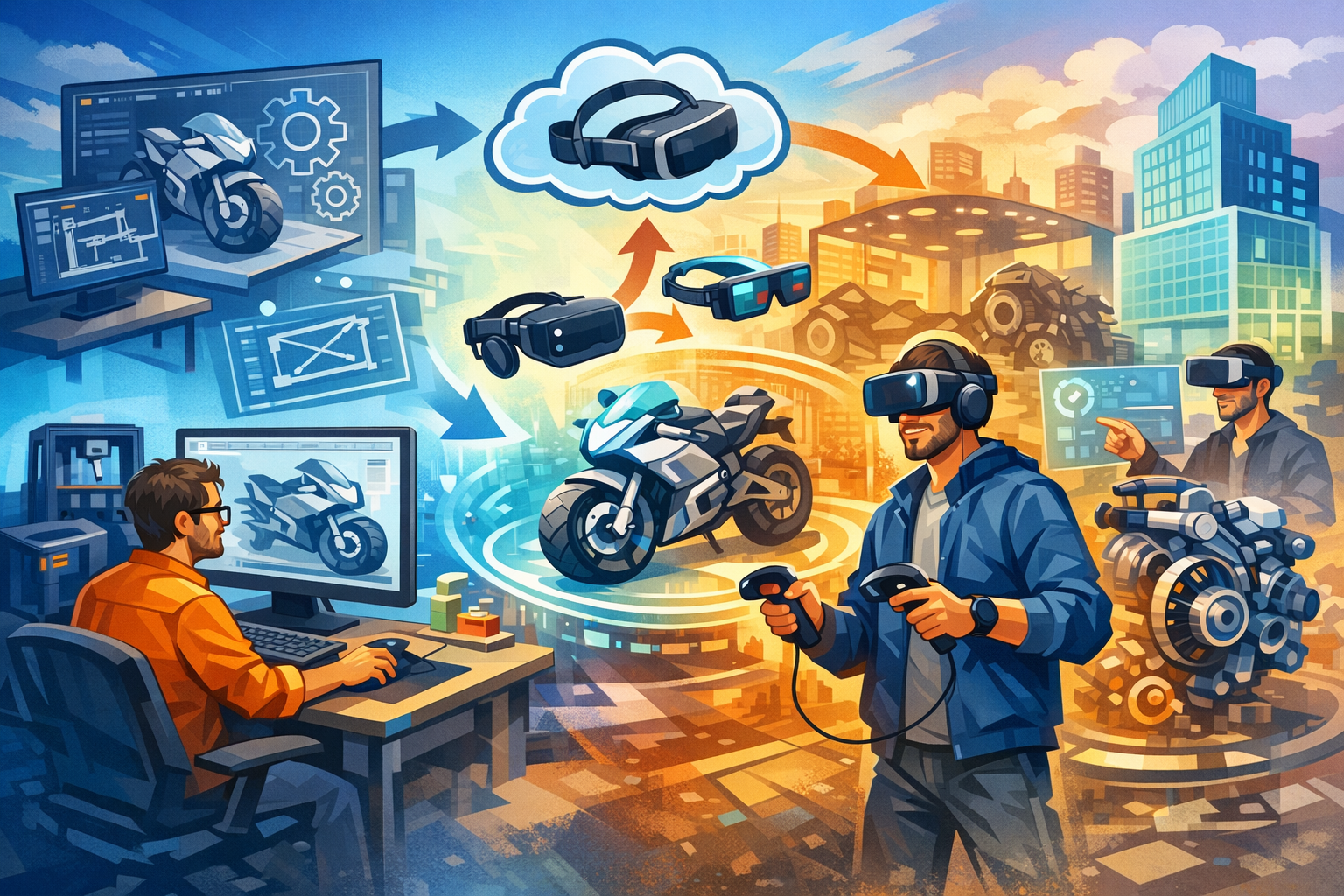


Immersive product demos have moved beyond novelty. In many design and engineering organizations, they are becoming a practical way to translate complex product data into experiences that stakeholders can understand quickly and evaluate with greater confidence. Where static renderings, technical PDFs, and slide presentations once carried most of the communication burden, teams now increasingly rely on interactive XR environments to present not only how a product looks, but also how it behaves, fits, assembles, and supports a user task. This shift matters because modern products are more configurable, more software-driven, and often more difficult to explain through conventional media alone.
What makes this transformation especially important is that immersive demos are no longer built from isolated marketing assets. They are increasingly derived from the same engineering models used for design, validation, and manufacturing planning. That change has elevated the immersive demo from a promotional artifact to a strategic deliverable tied directly to the design software ecosystem. When implemented well, the process creates a new layer of value from existing CAD data, strengthens communication across departments, and shortens the path from technical definition to customer understanding.
Why immersive product demos are becoming a strategic design deliverable
For years, product communication depended on static images, videos, and presentation decks that translated engineering intent into visuals suitable for meetings, sales conversations, and launch campaigns. Those formats still have value, but they impose limits that become more obvious as products grow in complexity. A render can show surface quality and silhouette, but it cannot fully convey how a mechanism opens, how service access works, or how a user moves around the product in real space. A slide deck can summarize features, yet it often separates the object from the context in which decisions are made. By contrast, immersive environments provide a unified space where a product can be inspected, manipulated, and understood from multiple perspectives in a way that is closer to direct experience.
The move from presentation to participation
The strategic importance of this shift is rooted in interactivity. XR demos turn viewers into participants. Instead of passively receiving a design story, users can trigger animations, inspect assemblies, compare variants, and evaluate user interactions at full or contextual scale. That changes the quality of communication because understanding emerges through exploration. A product manager can examine packaging constraints, an engineer can verify whether assembly logic is intuitive, and a sales lead can demonstrate differentiating features without relying entirely on verbal explanation. The result is a more effective bridge between technical content and human comprehension, especially when products involve hidden systems, modular architecture, or specialized operating sequences.
Using CAD-driven demos to communicate what matters
One of the strongest arguments for immersive demos is that they help teams communicate several critical dimensions of product meaning at once. A properly structured CAD-driven XR experience can make product function visible by showing moving parts, state changes, and cause-and-effect relationships. It can clarify scale and ergonomics by placing the object in a room, next to a user avatar, or within task-based workflows. It can reveal assembly logic through exploded views, sequencing, and selective transparency. It can also communicate user interaction by simulating touch points, controls, interfaces, and operational feedback.
This is especially powerful in products that are difficult to understand from the outside. Industrial equipment, medical devices, consumer electronics with compact internal packaging, and architectural systems all benefit when stakeholders can access multiple layers of information without switching between disconnected media. Instead of alternately reviewing CAD screenshots, technical notes, and animated clips, teams can rely on one immersive environment that preserves object context while exposing structure, behavior, and intended use.
Business value across departments
The business case for immersive demos becomes stronger when viewed across the organization rather than as a marketing tool alone. Different departments extract different forms of value from the same experience, which improves asset reuse and justifies deeper workflow integration. Teams that once produced separate communication materials for engineering reviews, customer presentations, and training can now derive multiple outputs from a coordinated XR pipeline.
Typical organizational benefits include:
- Sales: clearer product explanation, faster objection handling, more persuasive remote demonstrations, and better communication of premium features or optional configurations.
- Engineering: improved design review clarity, stronger cross-functional alignment, and easier communication of intent to non-technical stakeholders.
- Marketing: access to richer visual content, more engaging launch material, and a stronger narrative connection between product attributes and customer value.
- Customer training: safer onboarding for complex equipment, guided procedural learning, and repeatable simulation-based instruction without requiring physical inventory.
What makes this especially significant is the reuse of source data. When CAD models, material definitions, assembly structures, and product metadata are preserved and transformed intelligently, organizations reduce duplicate effort. Instead of rebuilding explanatory assets from scratch for every audience, they can adapt a shared digital foundation for each communication purpose.
The convergence changing expectations
The convergence of CAD, visualization software, and XR platforms is changing what stakeholders expect from product presentation. As real-time rendering becomes more photorealistic and XR hardware becomes more accessible, audiences increasingly assume they should be able to inspect a product interactively rather than infer its value from static images. This is not merely a matter of visual sophistication. It reflects a broader expectation that digital product information should remain connected, explorable, and responsive throughout the lifecycle.
That expectation affects both internal and external communication. Internally, executives increasingly want design reviews that show the consequences of decisions in a spatially coherent environment. Externally, buyers and partners expect product demonstrations that match the quality and immediacy they encounter in advanced digital commerce and simulation-driven training. As a result, immersive demos are becoming a serious extension of the design software stack: not an isolated media output, but a high-value layer that sits between engineering definition and real-world understanding. Organizations that recognize this early are better positioned to communicate design intent with precision, speed, and impact.
Building the workflow from CAD model to XR-ready experience
Turning an engineering model into a successful immersive demo requires much more than exporting geometry into a headset-compatible format. CAD data is created for precision, revision control, and manufacturability, while XR environments are built for responsive interaction, real-time rendering, and clear user experience. The workflow between those worlds is where most quality gains or losses occur. If the pipeline is poorly managed, the result is often a visually heavy scene that performs badly, loses product structure, or misrepresents design intent. If the pipeline is carefully designed, the same engineering source can support accurate, performant, and compelling immersive communication across devices and audiences.
Preparing CAD data for immersive environments
The first major step is data preparation. Engineering models often contain geometric detail that is essential for fabrication but unnecessary or even harmful in real-time applications. Tiny fillets, internal fasteners, hidden hardware, and over-resolved surfaces can dramatically increase polygon count without improving user understanding. Effective geometry simplification removes or reduces such detail while preserving the aspects of form that communicate quality and function. This does not mean flattening the model visually. It means deciding which geometric information serves the immersive experience and which merely burdens the renderer.
At the same time, material assignment must be rethought for real-time use. CAD material definitions often encode engineering properties rather than appearance behavior. XR scenes need display-oriented material systems that support albedo, roughness, metallic response, normal detail, transparency, and sometimes procedural variation. A disciplined pipeline maps engineering materials into render-ready materials in a way that preserves design meaning while producing consistent visual results across platforms. Alongside this, hierarchy cleanup is essential. Assembly trees in CAD may reflect modeling history or enterprise structures that are confusing in interactive applications. Reorganizing components into logical groups improves selection, animation, exploded views, and user navigation. Finally, metadata organization ensures that part names, functional categories, version tags, maintenance notes, and configuration logic remain usable after export rather than being lost in translation.
Preserving design intent in real-time assets
A common misconception is that optimization inevitably weakens accuracy. In reality, the most sophisticated workflows protect design intent precisely because they separate what must remain exact from what can be approximated for speed. Critical silhouettes, motion relationships, user touchpoints, interface regions, and dimensional reference cues should survive conversion faithfully. Less critical surface density, hidden internals, duplicated fasteners, and imperceptible curvature detail can often be reduced substantially. The art of conversion lies in understanding which aspects of the CAD model carry communicative importance within the XR context.
Teams that do this well typically establish conversion rules based on use case. A technical review demo may preserve more assembly logic and annotation hooks, while a sales demo may prioritize exterior fidelity, interaction smoothness, and lighting quality. Maintaining design intent also requires consistency in scale, pivot locations, kinematic constraints, and naming conventions. Without these, interaction systems break down. A door may rotate from the wrong axis, a configuration switch may fail to isolate the correct components, or annotations may point to ambiguous objects. The conversion process therefore needs to be treated as a structured interpretation of engineering data, not a one-click export task.
Key stages in the software pipeline
Most robust workflows move through a recognizable sequence of stages, even if different organizations use different software combinations. Understanding these stages helps teams identify where quality should be controlled and where automation can be introduced.
- CAD authoring: products are modeled with accurate geometry, assembly relationships, and engineering attributes.
- Model optimization: geometry is simplified, UVs may be generated, materials are remapped, hierarchies are cleaned, and metadata is prepared for downstream use.
- Rendering integration: assets are imported into a real-time environment where lighting, shaders, interactions, animations, and interface elements are built.
- XR platform deployment: the experience is tuned for target hardware such as VR headsets, AR tablets, optical see-through devices, or mobile platforms.
Although these stages sound linear, effective pipelines are iterative. Changes discovered during XR testing often require adjustments upstream. For example, a performance issue in a standalone headset may reveal that LOD rules are too weak, material complexity is too high, or hierarchies are too fragmented for efficient scene management. Successful teams create feedback loops rather than forcing each stage to operate in isolation.
Balancing fidelity with performance
One of the defining challenges in immersive product demos is balancing visual richness with real-time responsiveness. A desktop workstation can render a dense scene with expensive lighting and complex shaders more easily than a mobile AR device or standalone VR headset. Yet users expect visual coherence across all platforms. This means teams must think in terms of performance budgets from the beginning. Polygon counts, draw calls, texture sizes, transparency usage, shader complexity, animation systems, and lighting strategy all need device-aware planning.
That balancing act is not purely technical; it also affects perception. A headset demo with slightly simplified geometry but stable frame rate and crisp interaction will usually feel more convincing than a visually heavier scene that stutters. In immersive contexts, performance is part of realism because delayed input, inconsistent motion, and low responsiveness break presence immediately. For this reason, optimization decisions should be guided by perceptual priorities. Preserve what users notice most, simplify what they rarely inspect closely, and deploy scalable asset variants for different platforms whenever possible. The goal is not maximum detail at all costs, but the best overall communication experience within hardware constraints.
Interoperability challenges between CAD, engines, and XR tools
Interoperability remains one of the most persistent barriers in the pipeline. CAD systems, digital content creation tools, game engines, and XR deployment platforms often rely on different assumptions about geometry types, coordinate systems, material models, naming rules, and metadata structures. Translation errors can appear in subtle but damaging ways: normals may flip, instancing may be lost, assemblies may collapse into unmanageable meshes, animations may fail due to renamed nodes, or material appearances may shift drastically between tools. Even unit mismatches can cause severe issues in ergonomic evaluation or AR alignment.
To manage this, advanced teams rely on strict data governance and repeatable conversion standards. Common best practices include:
- standardizing export formats per use case rather than mixing too many interchange methods
- maintaining naming conventions across authoring, optimization, and engine stages
- tracking version history so revised CAD does not silently break interactive setups
- testing material translation with reference scenes before full production
- preserving metadata through structured mapping rather than manual re-entry
As software ecosystems improve, these handoffs are becoming smoother, but they still require expertise. The most reliable immersive demo workflows are built not only on powerful tools, but on operational discipline that treats interoperability as a design problem in its own right.
Advanced techniques that make immersive product demos truly effective
Once a product is technically available in a real-time XR environment, the real design challenge begins. A model in space is not yet an effective demo. What distinguishes a useful immersive experience from a superficial one is the way interactivity, narrative structure, and product intelligence are combined to help a specific audience understand something meaningful. Advanced immersive demos do more than display surfaces. They reveal relationships, explain decisions, support comparison, and guide attention without eliminating the user’s freedom to explore. This is where design software thinking becomes especially important, because the demo itself must be architected as carefully as the product it represents.
Features that turn viewing into understanding
Some of the most valuable interactive mechanisms are deceptively simple. Exploded views remain highly effective because they make hidden structure legible while preserving assembly relationships. In XR, they are even more powerful because users can move around the expanded system and inspect each layer spatially. Configuration switching enables rapid comparison between product variants, accessory packages, material options, or internal component layouts. Animation triggers allow users to activate a mechanism only when they are ready, which improves comprehension compared with looping videos that may not align with the viewer’s attention. Guided walkthroughs help less technical audiences follow a curated sequence, while live annotation overlays context without separating explanation from the object.
These features are most effective when they are tied to clear communicative goals. A configuration switch should not exist merely because it is possible; it should reveal a meaningful decision difference. An exploded view should show assembly logic that would otherwise remain hidden. A guided walkthrough should shorten the time needed to grasp the value proposition or technical workflow. When interactivity is purposeful, immersive demos become analytical tools as much as presentation tools.
Enriching demos with simulation and behavior data
The next level of sophistication comes from incorporating product behavior data rather than relying only on visual form. Simulation outputs, kinematic logic, sensor states, airflow paths, thermal data summaries, and usage scenarios can all enrich an immersive demo when translated carefully. This does not mean importing raw engineering analysis unedited. It means converting behavior into forms that are understandable in context. A maintenance demo might visualize component temperatures with intuitive overlays. A machinery presentation might show force transmission through motion-linked highlights. A product launch experience might reveal how internal subsystems coordinate during operation through synchronized animation and annotation.
This approach expands the role of immersive demos from visual explanation to functional storytelling. It helps stakeholders understand not just what the product is, but why it is designed the way it is. It is particularly useful when strategic decisions depend on communicating hidden performance advantages. In these cases, the immersive experience can act as a layer of interpretive engineering communication, making simulation-informed insights visible to non-specialists without reducing them to simplistic claims. The best implementations preserve technical credibility while increasing accessibility.
Designing for technical reviewers, buyers, and operators
An immersive product demo should rarely be designed for a generic user. Different audiences need different layers of accuracy, context, and emotional framing. Technical reviewers usually need traceability between what they see and what the engineering model represents. They benefit from precise assembly grouping, dimensional references, selectable metadata, revision awareness, and the ability to inspect internal logic. Buyers, by contrast, tend to respond to clarity, confidence, and emotional impact. They may need fewer technical controls but stronger guidance, cleaner scene composition, and a more focused demonstration of differentiating benefits. Operators and trainees need usability cues, procedural clarity, safety guidance, and feedback that supports memory and correct action.
Audience-aware design often leads to modular experience architecture. The same base product scene can support multiple modes or layers, such as expert review, sales storytelling, and operational training. This approach is more efficient than creating entirely separate immersive assets because it reuses geometry, materials, and interaction systems while changing guidance, emphasis, and available controls. In practical terms, this may involve conditional annotations, selective visibility presets, role-specific UI panels, and different animation sequences. Such flexibility is one of the strongest reasons immersive demos are becoming strategic assets rather than one-off presentations.
Perceived realism: rendering, audio, and physics
Perceived realism in XR does not come from visual fidelity alone. It emerges from the consistency between what users see, hear, and feel through interaction. Real-time rendering contributes obvious value through believable materials, reflections, shadows, and lighting transitions, but these gains are amplified when paired with spatially coherent responses. Spatial audio can indicate where a mechanism engages, where airflow or motor noise originates, or whether the user has triggered the correct step in a training sequence. Physics-based interaction adds credibility by making manipulation feel constrained and purposeful rather than arbitrary. Even simple collision logic, snapping behavior, or weighted motion can dramatically improve the sense that the product is a functional object rather than a floating graphic.
These elements matter because users judge realism holistically. A beautifully shaded model that clips through surfaces or emits no contextual sound may feel less convincing than a slightly simplified model with strong interaction logic and responsive feedback. For advanced teams, the question is not how to maximize every sensory feature, but how to combine them to support belief, attention, and comprehension within hardware limits. Good immersive demo design is therefore as much about behavioral coherence as visual polish.
Measuring whether the demo actually works
Because immersive product demos are becoming strategic deliverables, they should be evaluated with more rigor than aesthetic approval alone. Effectiveness can be measured by observing how quickly users understand key features, how confidently they answer follow-up questions, how often they engage with important interaction points, and whether the experience reduces ambiguity in downstream decisions. Practical metrics vary by use case, but strong evaluation often includes a mix of engagement data, qualitative feedback, and business process indicators.
Useful measures may include:
- time spent on critical product features or interaction steps
- frequency of configuration comparisons or exploded-view activation
- stakeholder feedback on clarity, trust, and decision confidence
- reduction in meeting cycles needed to align around design intent
- improved training readiness or fewer support questions after exposure
Perhaps the most important signal is whether the immersive demo accelerates decisions without degrading understanding. If teams approve design directions faster, if buyers grasp product value with fewer follow-up materials, or if operators retain procedures more effectively, then the demo is doing meaningful work. That is the standard by which advanced immersive experiences should be judged: not by novelty, but by how well they convert complex product information into confident action.
Conclusion
Immersive product demos are rapidly evolving into a serious extension of the contemporary design software stack. Their significance lies not only in visual appeal, but in their ability to connect precise engineering data with spatial understanding, interaction, and decision support. As organizations look for better ways to communicate increasingly complex products, XR experiences offer a framework where form, function, assembly logic, and user behavior can be presented together rather than fragmented across separate documents and media. This makes immersive demos valuable far beyond product launch messaging. They are becoming part of how products are reviewed, explained, sold, and learned.
From isolated asset to connected workflow
The strongest workflows are those that reuse engineering data intelligently. When CAD models are prepared with optimization, hierarchy discipline, material translation, and metadata continuity in mind, companies can move from design definition to immersive presentation without rebuilding the story from scratch. That efficiency matters because it allows the same digital foundation to support engineering review, marketing communication, sales enablement, and operator training. In this sense, CAD and XR integration is not just a technical convenience. It is a way of increasing the strategic value of product information across the organization while reducing inconsistency between departments.
The future belongs to precision, storytelling, and interactivity
The most successful immersive demo pipelines will be the ones that combine three strengths at once: precision from engineering, storytelling from visualization, and responsiveness from interactive systems. If any one of these is missing, the experience becomes less useful. Precision without storytelling can overwhelm. Storytelling without accuracy can mislead. Interactivity without structure can distract. The advanced practice lies in orchestrating all three so the demo feels credible, clear, and memorable for different audiences and devices. That orchestration is what turns XR from a technical output into a design communication instrument.
Why this will likely become standard practice
As XR tools continue to mature, immersive demos will likely become standard in design review, product launch, and customer experience strategies. Hardware is improving, real-time engines are becoming more capable, and interoperability between design software platforms is gradually becoming more manageable. At the same time, stakeholder expectations are rising. People increasingly want to engage with products interactively, understand them in context, and explore them at the level most relevant to their role. For companies willing to invest in integrated workflows, this creates a clear opportunity: use immersive demos not as novelty experiences, but as durable, data-connected assets that improve communication throughout the product lifecycle. That is where their long-term strategic power truly resides.
Also in Design News