Your Cart is Empty


Augmented Assembly: Turning CAD/MBD into Executable XR Work Instructions for the Digital Thread


Why Augmented Assembly from CAD Changes the Shop Floor
Defining augmented assembly instructions
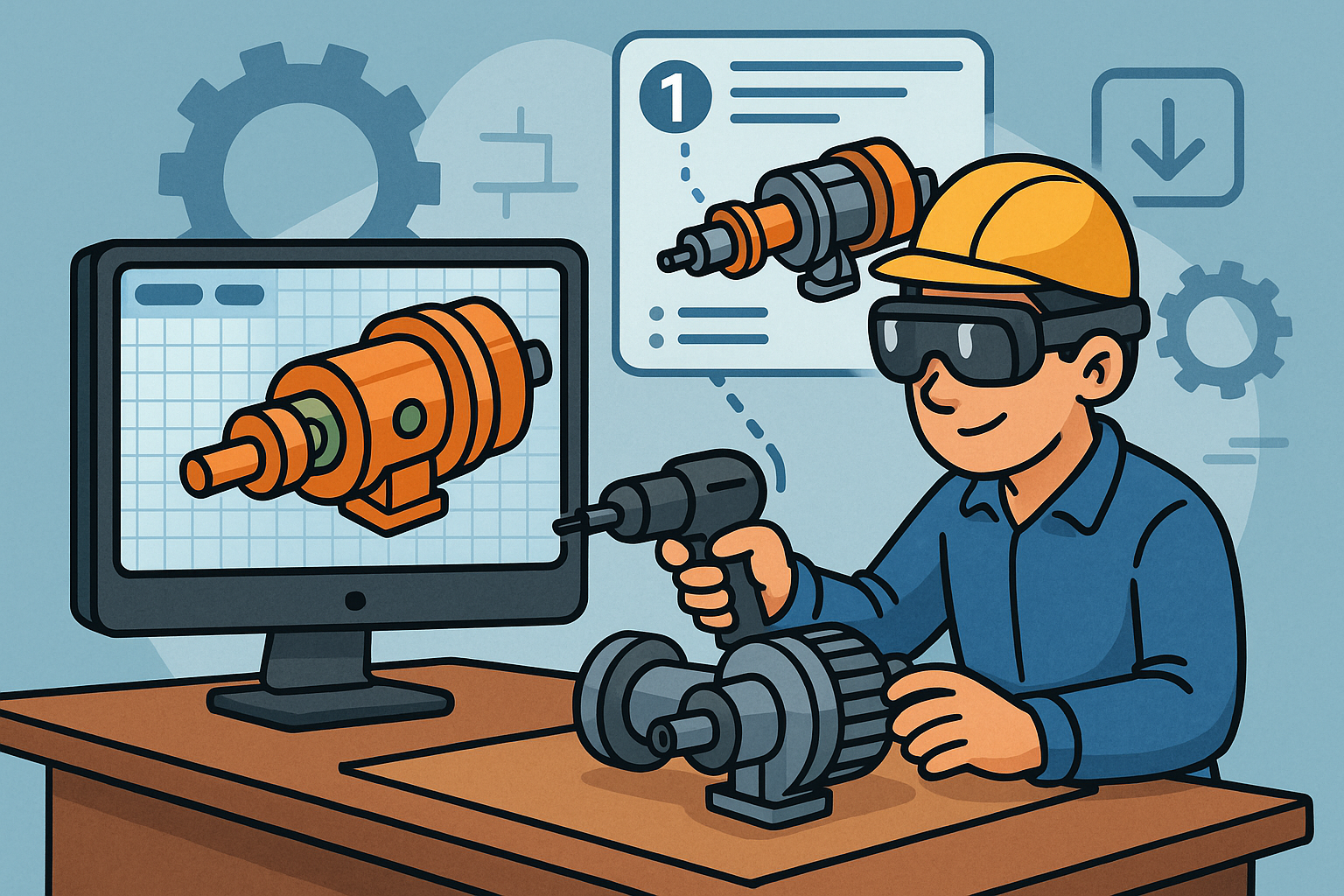
Augmented assembly instructions are the translation of authoritative engineering data into **spatially anchored, step-by-step guidance** that runs directly where work happens. In practice, this means that an XR device—augmented or mixed reality—overlays interactive prompts, part highlights, and validation cues onto the physical work area, with every instruction derived from the same CAD/PLM source that defines geometry and intent. Rather than retyping or redrawing work instructions, the system fuses 3D models, PMI/GD&T, and process plans into an **executable overlay** that removes guesswork. Each step is not just a sentence; it is a structured micro-procedure with targets, tolerances, required tools, and acceptance criteria, all synchronized with the state of the job. If a technician needs to install a bracket, the instruction can ghost the target surface, render a direction arrow along the mate axis, enforce torque/angle limits, and require a visual or sensor-based verification before allowing the process to advance. This is more than visualization; it is a live, traceable operational definition of how to realize the design, yielding consistency across variants and shifts. The practical outcome is a unified, **Model-Based Definition (MBD)** experience that bridges design intent and operator action in a way that paper and flat screens cannot.
- Spatial anchoring locks instructions to real geometry for hands-free clarity.
- Authoritative CAD/PLM sources ensure change control and a single source of truth.
- PMI/GD&T become enforceable constraints, not just annotations.
- Interactive overlays drive step gating, verification, and traceability.
Business outcomes to target and measure
Organizations should approach augmented assembly with a focus on measurable impact rather than novelty. The most direct levers are training speed, right-first-time quality, and predictable throughput. By presenting just-in-time, spatially relevant prompts, teams consistently report lower cognitive load and faster time-to-proficiency for new operators compared with static paper or 2D tablets. The overlay removes ambiguity about which hole, which fastener, or which orientation is correct, leading to **higher first-pass yield** and fewer deviations. Even experienced assemblers gain from automated checks that catch edge cases and variant-specific differences, especially in high-mix environments where memory-based reliance fails. The instruction layer also writes its own audit log, linking each micro-step to operator identity, versions, and environmental conditions. This traceability eases compliance and accelerates root-cause analysis when issues arise. To keep the program grounded, define KPI baselines and track deltas by station and variant. A practical approach is to instrument both performance and perception, aligning shop-floor experience with quantitative gains.
- Reduce training hours per station and ramp-up time for cross-trained staff.
- Lower defects/rework, stabilize cycle time, and reduce takt variability.
- Automate step-level logging for compliance and **closed-loop traceability**.
- Track operator cognitive load via task time dispersion and error categories.
- Correlate improvements to instruction versioning and design changes.
Position in the digital thread
Augmented assembly sits squarely in the **digital thread**, translating design and manufacturing data into guided execution and feeding results back to enterprise systems. It links EBOM to MBOM, then to routings and operations, and finally to **XR work instructions** that reflect the current effectivity of parts and processes. As assemblies move from engineering to production, the XR layer preserves continuity with MBD: PMI/GD&T flow directly into in-situ tolerances, datum alignments appear as spatial references, and change notices drive automatic updates to affected steps. Integrations with PLM keep configuration-controlled variants synchronized, while MES and QMS consume step telemetry to validate conformance and detect systemic drifts. In practice, this means a fastener spec change in PLM can trigger an instruction refresh, a new torque profile in the tool’s configuration, and a revised acceptance criterion in the verification step—without manual redlining. When every execution is recorded with precise context—who, when, where, which version—the organization unlocks analytics that refine both product and process iteratively. This is the thread’s promise realized on the shop floor: **design intent becomes executable**, and operations produce insight rather than opaque outcomes.
- EBOM → MBOM → Process Plan → XR Instruction → MES/QMS feedback loop.
- Change control and effectivity rules propagate to the line automatically.
- MBD continuity ensures tolerances and datums guide real-world assembly.
- Execution data enriches PLM/MES with grounded, station-level evidence.
High-value initial use cases
Early efforts benefit from selecting tasks where spatial context and verification yield outsized returns. Complex, multi-variant assemblies are ideal because XR clarifies which configuration applies and visualizes differences without retraining. Operations where torque, angle, or sequence drive quality—think structural fasteners, preload-sensitive joints, or safety-critical clamps—gain from tool integration that verifies signatures in real time. Routing tasks (wiring, hoses) are notoriously hard to convey on paper; **path-guided overlays** with bend radius warnings and clip placement are natural fits. Sealants and adhesives benefit from dynamic sectioning that exposes bond lines, while in-process inspections translate GD&T into visualizable checkpoints and go/no-go cues. Finally, service procedures can use the same data foundation to guide disassembly, part identification, and reassembly with updated parts. By focusing here first, teams maximize early value, build operator trust, and generate the telemetry needed to refine both content and alignment strategies.
- Multi-variant assemblies with part look-alikes and option codes.
- Torque/sequence-critical operations with tool feedback and step gating.
- Harness and hose routing with **ghosted targets** and path hints.
- Sealant/adhesive application with dynamic sectioning and timers.
- In-process inspection steps derived from PMI/GD&T callouts.
- Service procedures leveraging the same XR-ready assets and rules.
Authoring Pipeline: From CAD and MBOM to XR-Ready Procedures
Structure the source of truth
The authoring pipeline begins with rigorous definition of the source of truth. Extract the assembly graph, mates/constraints, PMI/GD&T, and metadata from CAD via STEP AP242, JT, or native APIs, ensuring that model semantics—not just triangles—are available for downstream logic. Map EBOM to MBOM, then to routings and operations that capture tools, torque/angle, consumables, and safety notes. This mapping should preserve traceability to part numbers, variant rules, and effectivity dates, enabling dynamic instruction selection on the line. Manage complexity through a **150%-BOM** with configuration logic that prunes parts by option, serial, or region; when variants require feature-level differences, parameterize geometry to maintain a consistent instruction skeleton. Align naming conventions and units early to avoid downstream mismatches, and normalize coordinate systems so assemblies behave predictably in XR runtimes. With a clean foundation, content can be composed programmatically and audited efficiently, avoiding ad-hoc modeling or duplicated work instructions that drift.
- Import geometry and semantics: STEP AP242, JT, and native CAD APIs.
- Preserve PMI/GD&T, mate features, and fastener patterns for logic.
- Map EBOM → MBOM → operations with tools, torque, and consumables.
- Drive variants via 150%-BOM and effectivity rules; parameterize if needed.
- Normalize units, axes, and naming to reduce XR integration friction.
Derive executable steps
Once the source is structured, derive executable steps that reflect real assembly precedence. Mates, contact surfaces, and fastener patterns inform a directed acyclic graph of operations that can be validated with interference and collision checks. Each operation decomposes into **micro-ops**—position, insert, fasten, verify—each with acceptance criteria, timers, and tool bindings. This structure avoids monolithic instructions and enables step-level logging and rework branching. Visual assets should be auto-authored wherever possible: ghosted targets for clarity, exploded paths to reveal insertion direction, dynamic sectioning to expose hidden datums, and **path hints** for harness routing that respect minimum bend radii. Acceptance criteria map to modality: a torque-time-angle signature, a presence/orientation vision check, or a GD&T tolerance envelope measured with a gauge. By encoding the “why” along with the “how,” authoring enforces design intent and reduces ambiguity that leads to rework.
- Compute precedence from mates, constraints, and fastener groups.
- Run collision/interference checks to catch sequencing errors early.
- Define micro-ops with timers, acceptance criteria, and rework paths.
- Auto-generate visuals: ghosting, exploded vectors, and section cuts.
- Embed measurement logic aligned to PMI/GD&T for verification steps.
Optimize content for XR runtimes
Rendering fidelity must balance realism with performance and operator comfort. Convert CAD solids to meshes optimized for XR: apply mesh decimation tuned by silhouette preservation, create LODs for near/far efficiency, and clean pivots so transforms align with physical affordances (e.g., hinge axes). Normalize axis conventions and units to avoid mirrored or mis-scaled overlays. Budget draw calls and texture memory, and consider tooling or fixtures as separate layers for selective visibility. Package runtime assets in **glTF/GLB** for efficient on-device use, leveraging PBR materials to emphasize edges and contact cues without visual clutter; maintain **USD** master scenes for assembly and interchange across departments. Localize text and audio early to avoid manual duplication, and attach multimodal prompts—voice, haptics, or tool feedback—to ensure clarity with PPE or high-noise environments. A predictable content profile leads to consistent frame rates and operator trust, especially during precise alignment tasks.
- Mesh decimation and LODs to sustain smooth, low-latency overlays.
- Pivot cleanup, axis normalization, and unit consistency across assets.
- Draw-call and texture budgets aligned to device capabilities.
- PBR-tuned materials that highlight **contact surfaces** and edges.
- glTF/GLB for runtime, USD for scene assembly and pipeline integration.
- Localized text/audio and multimodal prompts for accessibility.
Govern change and quality
Instruction integrity depends on tight governance, especially as designs evolve. Version steps and assets independently, and compute geometric diffs to visualize what changed—surfacing **change heatmaps** that inform impacted instructions. Tie work-instruction versions to PLM change notices so effectivity cascades to the floor without manual edits; automatically flag steps that reference modified geometry, tolerances, or tools. Validate instructions with virtual dry-runs that are physics-aware to catch unrealistic gestures, clearances, or unreachable fasteners before deployment. Pilot captures on the line should record operator path, gaze, and timing to refine pacing and highlight confusion points; feed these insights back into content updates through a structured review cycle. By treating instructions as governed product assets with clear lineage, organizations avoid silent divergence between the model and the method—ensuring the XR layer remains a trustworthy, auditable reflection of current intent.
- Independent versioning of steps, visuals, and logic with lineage.
- Geometric diffs and **heatmaps** flag impacted steps automatically.
- PLM-linked effectivity ties instructions to approved change notices.
- Physics-aware virtual dry-runs catch feasibility issues early.
- Pilot captures and structured reviews tighten quality loops.
XR Delivery, Spatial Alignment, and In-Process Verification
Hardware and ergonomics trade-offs
Choosing hardware is as much about human factors as technical capability. Head-worn devices (optical see-through or pass-through MR) offer hands-free operation and stable overlays but vary in field of view, occlusion handling, and **PPE compatibility**. Tablets running ARKit/ARCore are flexible for shared use and are less intrusive under hard hats or respirators, but they occupy a hand and rely on camera framing discipline. Battery life, heat, weight distribution, and hygiene are nontrivial factors during multi-shift use, as are environmental constraints such as lighting, dust, noise, and glove usage. Cleanrooms demand low-particulate devices and wipe-down-friendly materials, while welding bays challenge sensors with sparks and infrared noise. Rather than converging on a single device, many operations map station types to modalities: alignment-critical cells use headsets, documentation-heavy or inspection-only stations use tablets. The most successful deployments treat hardware as an interchangeable client to a consistent runtime and content profile.
- Headsets: larger FOV and hands-free flow; consider occlusion fidelity and comfort.
- Tablets: fast to share and rugged; one-hand constraint and framing discipline needed.
- Industrial realities: dust, lighting, noise, and glove-driven input choices.
- Battery and heat budgets must match takt and shift patterns.
- Hygiene, cleanroom compliance, and PPE fit drive device selection.
Robust alignment on the line
Spatial alignment is the backbone of trustworthy overlays. Initial pose can be bootstrapped with fiducials such as AprilTags/ArUco or QR codes on fixtures, or with machined reference features in jigs. Device VIO/SLAM establishes persistence across steps and minor operator motion. For fine alignment, depth-assisted model tracking and ICP against scanned geometry refine the overlay to sub-millimeter accuracy where feasible; drift correction should run continuously and recover smoothly after occlusions or motion bursts. To enhance resilience, anchor instructions locally at the step-level—e.g., align the current subassembly or fastener group—so minor global drift does not derail the task. When confidence drops below threshold, the system should surface re-localization cues like “look at tag X” and offer a **manual alignment** fallback that reprojects reference edges and lets the operator nudge them into place. A layered approach keeps guidance trustworthy despite environmental dynamics.
- Initial pose: fiducials, jigs, and fixture QR codes for deterministic starts.
- Device VIO/SLAM provides persistence across motions and steps.
- Fine alignment: depth tracking and ICP against live geometry.
- Continuous drift correction with confidence-driven prompts.
- Step-local anchors and manual fallback mitigate re-localization gaps.
Runtime architecture and integration
The runtime should be device-agnostic, ideally built on OpenXR to abstract hardware differences while enabling sophisticated features per platform. On-prem or edge rendering reduces latency, improves security, and supports heavier scenes, while offline caching maintains continuity in air-gapped or poor-connectivity cells. Secure content distribution and device management ensure that only the right **effectivity**-matched instruction set reaches each station. Tool and sensor integrations transform XR from a guide into a verifier: smart torque wrenches stream signatures for gating, barcode/RFID confirms part identity, vision systems check orientation and label correctness, pick-to-light directs kitting, and AGVs notify operators of incoming WIP. Architecture must treat these signals as first-class citizens, fusing them into step logic and telemetry. A modular, message-driven design isolates device specifics and allows new sensors to slot in without rewriting instruction content.
- OpenXR-based clients unify headset and tablet delivery pipelines.
- Edge rendering and caching support low-latency and offline operation.
- Secure distribution with per-station effectivity and role-based access.
- Integrations: torque tools, barcode/RFID, vision, pick-to-light, and AGVs.
- Event-driven logic captures sensor inputs as **gating evidence**.
Human-in-the-loop UX patterns
Great XR instructions respect the realities of gloved hands, noisy floors, and varied operator preferences. Micro-interactions like gaze-dwell, simple gestures, or large on-screen affordances reduce friction; foot pedals or tool triggers can double as confirmation inputs for sterility or convenience. Step gating should be explicit yet lightweight, with checklists or callouts that align to acceptance criteria without overloading attention. Safety overlays matter: highlight pinch zones, required PPE, and ESD reminders, and surface context-aware warnings when a hand approaches a rotating hazard or when a step requires a lockout. Accessibility options are essential—adjustable contrast, text size, audio narration, and **left/right-handed modes** broaden usability and reduce fatigue. The key is progressive disclosure: show only what matters for the next action, allow quick backtracking, and keep global status visible to preserve situational awareness.
- Hands-free inputs: gaze/voice for headsets; large touch targets for tablets.
- Alternative triggers: foot pedals and tool buttons for step confirmations.
- Safety overlays for pinch points, PPE checks, and ESD precautions.
- Accessibility: contrast, font scaling, narration, and handedness controls.
- Progressive disclosure avoids clutter while maintaining context.
In-situ QA and closed-loop data
Embedding verification into the instruction flow turns guidance into **process control**. Vision modules check presence, orientation, label correctness, or color coding in real time; torque-time-angle signatures validate fastener integrity beyond a single scalar threshold. For geometry, go/no-go envelopes tied to GD&T enable tolerance-aware pass/fail with explicit uncertainty bounds, reducing false alarms in marginal lighting or reflective surfaces. Each check auto-captures evidence—images, tool traces, environmental metadata—and attaches it to the step record, creating a defensible audit trail. Streaming step metrics to MES/QMS completes the loop, allowing real-time dashboards and historical analysis. Process mining across this data unmasks bottlenecks and error hotspots at the granularity of micro-ops, informing targeted improvements to content, tooling, or fixtures. The outcome is a virtuous cycle: better instructions produce better data, and better data produces better instructions and designs.
- Computer vision verifies presence/orientation/labels inline with work.
- Torque-time-angle signatures enforce robust fastener quality.
- GD&T-derived go/no-go geometries with uncertainty bounds minimize noise.
- Auto-captured evidence improves **traceability** and compliance.
- MES/QMS integration enables process mining and continuous improvement.
Conclusion
From static documentation to executable guidance
Augmented assembly instructions elevate CAD from static documentation to an **executable, spatially precise process guide**. Instead of asking operators to interpret drawings and transpose them onto complex geometry, XR aligns intent with reality in the same coordinate space. PMI/GD&T move from marginalia to operational constraints, and routing and sequence become guided experiences that are validated in-line. This shift reduces ambiguity and rework because correctness is defined, visualized, and measured at the moment of action. It also produces inherently rich data: every confirmation, tool trace, and image is tied to step, variant, and design context. As a result, the organization no longer relies on tribal knowledge to enforce quality; it encodes design rationales into repeatable micro-ops and verifies outcomes continuously. The tight loop between design and execution is not aspirational—it is the practical effect of turning MBD into interactive, governed overlays that workers can trust and that systems can audit.
- XR makes design intent tangible and verifiable at the point of work.
- Instructions evolve from words and pictures to governed micro-ops.
- Evidence capture transforms execution into analyzable, reusable knowledge.
Prerequisites for dependable deployment
Succeeding with augmented assembly requires more than headsets. The real work lies in curating clean MBOM/process data, building a governed authoring pipeline, maintaining robust **spatial alignment**, and integrating tightly with PLM, MES, and QMS. Without coherent EBOM→MBOM mappings or effectivity rules, the wrong steps reach the wrong station. Without versioned instructions and geometric diffs, change control breaks and trust erodes. Alignment stack choices—from fiducials to ICP—determine whether overlays feel magical or maddening. And integrations with torque tools, barcode/RFID, and vision systems turn XR from a tutorial into a closed-loop controller. Treat each area as a capability with owners, SLAs, and metrics, not a one-off project. When these prerequisites are met, XR becomes a repeatable part of the digital thread instead of a fragile point solution.
- Data foundation: EBOM/MBOM integrity, effectivity logic, and naming standards.
- Governed authoring: versioning, diffs, and physics-aware dry-runs.
- Alignment resilience: multi-layer pose strategies and manual fallback.
- System integrations: PLM/MES/QMS synchronization and sensor gating.
Proving value and scaling with intention
The fastest path to credibility is to start small where the pain is acute and measurable. Choose a high-mix, high-error cell with variant complexity or torque/sequence sensitivity. Instrument KPIs—**first-pass yield**, cycle time, training hours, and deviations—before deployment, then A/B test instruction versions to isolate gains. Iterate on UX, alignment, and micro-op definitions until guidance is reliable at shift pace, not just in a lab demo. As confidence grows, scale by cloning patterns across similar stations and reusing instruction components that share geometry or process logic. Avoid the temptation to boil the ocean; a well-governed content library and a repeatable deployment playbook will carry farther than a sprawling proof-of-concept. Make operators co-authors through feedback and quick-turn updates, so improvements compound week over week.
- Target a contained, high-impact cell with measurable error sources.
- Baseline KPIs and run controlled comparisons across instruction versions.
- Refine UX and alignment in production conditions, not just pilots.
- Scale via reusable components and station archetypes, not one-offs.
What’s next on the near horizon
Several advances will amplify the value of augmented assembly in the near term. **Generative step authoring from MBD** will automate large portions of instruction creation by leveraging mates, PMI/GD&T, and fastener patterns to propose micro-ops and visuals that authors approve rather than handcraft. Semantics-rich USD pipelines will improve interoperability, allowing design, manufacturing, and XR teams to share scene graphs and metadata with minimal translation. On-device vision will enable more robust auto-verification, even in challenging lighting, by combining depth sensing with learned features tuned to factory textures. Finally, analytics that fuse execution traces with design history will recommend tolerance adjustments, fixture improvements, or sequence changes—closing the loop not only on process execution but also on product evolution. Organizations that prepare their data models and governance now will be positioned to adopt these capabilities quickly and compound their advantage.
- Model-aware generation of steps, visuals, and acceptance criteria.
- USD-centered scene and metadata exchange across the enterprise.
- Edge vision models for reliable verification under factory conditions.
- Design-process analytics that continuously refine both product and method.
Also in Design News